
By Joe Cannon, MS
MS Exercise Science | BS Chemistry & Biology
Investigating dietary supplement research since the 1990s
Updated September 2026. This Healing Leaves Tea review looks at one of the more unusual health teas I’ve come across. Created by Jordan Rubin, Healing Leaves combines the leaves of fruit trees such as mulberry, fig, hawthorn, papaya, soursop, blackberry, and others. The company calls it a biblically inspired, caffeine-free tea and promotes it for digestion, immune function, healthy inflammation, natural energy, blood sugar, and overall wellness. The company also repeatedly refers to its ingredients as “12 studied fruit leaves” and says laboratory and clinical studies confirm the benefits of compounds contained in fruit-tree leaves. But what does “studied” really mean?
In this Healing Leaves Tea review, let’s look at the research and see what we can figure out.
Quick Answer: Does Healing Leaves Really Work?
I could not locate a published human clinical trial of Healing Leaves itself.
Some individual ingredients do have human research, especially mulberry leaf for blood-sugar control. Hawthorn, persimmon, papaya, fig, and raspberry leaves also have varying amounts of human evidence.
However, Healing Leaves does not disclose how much of each leaf is present, so we cannot tell whether it provides doses comparable to those used in clinical studies.
I also found several issues, including conflicting capsule ingredient information, differences between the tea and capsules, and unanswered questions about long-term soursop safety.
Bottom line: Healing Leaves contains some promising ingredients, but it doesn’t appear to be clinically proven.
Healing Leaves Tea Video Review
Prefer to watch instead of read? Watch my Healing Leaves Tea review on YouTube. In this Healing Leaves Tea review, I look at the human research behind its ingredients, including mulberry leaf and blood sugar, the AB22 probiotic, and the questions surrounding soursop and annonacin. I also compare the tea and capsule formulas and examine whether the product’s “biblically inspired” description is supported by the Bible passages cited by the company.
How I Researched Healing Leaves
For this review, I examined the current Healing Leaves product pages, FAQs, Supplement Facts labels, ingredient descriptions, company information, customer reviews, subscription policy, return policy, and health claims.
I also searched the published medical literature for human research on the individual fruit-tree leaves. When human studies existed, I looked at the population studied, dose, preparation, study duration, and outcomes.
What Is Healing Leaves?
Healing Leaves was created by Jordan Rubin, author of 31 books and founder of Garden of Life, Beyond Organic, and Ancient Nutrition.
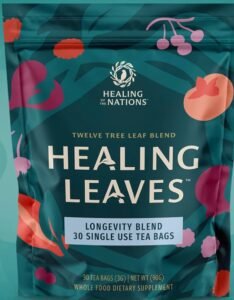
According to Healing Leaves, Rubin reviewed the leaves of more than 1,500 fruit trees before selecting 12 for the formula. The company says nearly one million fruit trees have been planted on its Regenerative Organic Certified farms in Tennessee and Missouri.
Healing Leaves is available as:
- tea bags
- loose-leaf tea
- capsules
The tea is caffeine-free.
The company describes Healing Leaves as a daily wellness ritual containing naturally occurring phytonutrients such as polyphenols and flavonoids
Is Healing Leaves really from the Bible?
Healing Leaves is inspired by Ezekiel 47:12 and Revelation 22:2. However, those passages don’t describe a specific 12-leaf tea combination.
The book of Revelation describes the Tree of Life bearing twelve crops of fruit and says its leaves are “for the healing of the nations.” Ezekiel similarly describes fruit trees whose fruit is used for food and whose leaves are for healing. But the Bible does not specifically identify the fruit or leaves.
The Bible does mention some fruits and plants, including figs and grapevines, but it does not identify the 12 specific leaves used in Healing Leaves or advise people to combine them into a healing drink.
Something else, the Bible does not mention tea. No Bible passages describe brewing or drinking tea leaves in water and using it as a healing beverage.
So while Healing Leaves is biblically inspired, drinking these 12 specific leaves appears to be a modern creation.
What Does Healing Leaves Claim To Do?
Healing Leaves says the formula supports:
- Digestive health
- Immune system function
- A healthy inflammatory response
- Natural energy levels
- Healthy blood sugar
Later in this review, I’ll compare those claims with the human evidence.
Healing Leaves Ingredients
The written tea formula contains 12 fruit-tree leaves.
| Ingredient | Human research? | My assessment |
|---|---|---|
| Mulberry leaf | Yes, multiple trials | Strongest evidence |
| Hawthorn leaf | Yes | Interesting, but preparations vary |
| Persimmon leaf | Yes | Some encouraging research |
| Fig leaf | Very limited | Preliminary |
| Papaya leaf | Yes | Mostly platelet research |
| Raspberry leaf | Yes | Mostly pregnancy research |
| Soursop leaf | Very limited | Safety deserves attention |
| Blackberry leaf | Little human evidence | Mostly laboratory research |
| Sugarberry leaf | Little human evidence | Mostly laboratory research |
| Apple leaf | Little human evidence | Mostly laboratory research |
| Aronia leaf | Little human evidence | Don’t confuse with aronia berry research |
| Muscadine grape leaf | Little human evidence | Don’t confuse with grape or seed research |
Let’s look at the ingredients with the most useful human evidence.
Mulberry Leaf Research
If I had to pick the Healing Leaves ingredient with the best human evidence, mulberry leaf would probably be number one.
A systematic review and meta-analysis evaluated 12 clinical trials involving 615 adults. Overall, mulberry leaf or mulberry leaf extract modestly improved several measures of glucose control, including fasting glucose, HbA1c, and fasting insulin.
One reason mulberry may affect blood sugar is a compound called 1-deoxynojirimycin, usually abbreviated DNJ.
DNJ inhibits alpha-glucosidase, an intestinal enzyme involved in carbohydrate digestion. Slowing carbohydrate breakdown can reduce the rise in blood sugar after eating.
In one randomized study, 12 mg of DNJ was the minimum amount that significantly reduced post-meal blood glucose.
Another clinical trial tested mulberry extracts containing different amounts of DNJ and also reported reductions in post-meal glucose.
How much DNJ is in Healing Leaves?
Because Healing Leaves is a multi-leaf tea product, the exact amount of each leaf will naturally vary somewhat from serving to serving. This is especially true for the loose tea. That said, with the capsules, this information should be known because proprietary blend ingredients must be listed in descending order by weight.
This means the capsules contain more fermented wild blackberry leaf than mulberry leaf, because blackberry is listed first.
Fig Leaf And Blood Sugar
Fig leaf also has human research, although not much so far. One study involved only 10 adults with type 1 diabetes.
Results of that trial showed that, after eating, glucose was lower during the fig-leaf period, and insulin requirements decreased.
Encouraging; however, it was a small study (10 people), and two of the people dropped out.
Other researchers have studied abscisic acid a compound found in figs, for its effects on blood sugar. But research on fig fruit or isolated ABA does not prove that fig leaves have the same effect.
Persimmon Leaf Research
Persimmon leaf has more human research than I expected.
A 2025 systematic review and meta-analysis identified 16 randomized studies involving 1,572 people.
Persimmon leaf preparations were associated with improvements in total cholesterol, LDL, and triglycerides.
That sounds encouraging, but a problem is some of the studies allowed people to use persimmon leaf alongside conventional treatments. This leaves open the question of how effective persimmon leaf by itself is at reducing blood lipids.
Hawthorn Leaf Research
Researchers have studied hawthorn for cardiovascular effects for many years.
A 2025 meta-analysis evaluated six placebo-controlled trials of hawthorn at doses ranging from around 250 to 1,200 mg per day; it lowered blood pressure in some of the studies
Healing Leaves does not tell us the amount of hawthorn in a serving.
So hawthorn has legitimate human research, but we cannot assume the amount in Healing Leaves has the same effect as the amounts used in clinical trials.
Papaya Leaf Research
Papaya leaf has a good amount of human research.
Most of that research involves improving blood platelet levels.
A systematic review of four clinical trials noted papaya leaf use was associated with increased platelet counts in people infected with the dengue virus.
Raspberry Leaf Research
Raspberry leaf has mainly been studied in connection with pregnancy and labor.
One randomized trial involved 192 pregnant women who took 2.4 g of raspberry leaf daily beginning at 32 weeks.
It did not shorten the first stage of labor.
In another study, 10 grams (10,000 mg) of raspberry leaf tea was shown to lower blood sugar when it was given to 22 healthy adults after they consumed a sugar-laced beverage.
This research tells us very little about Healing Leaves’ claims involving immunity, energy, inflammation, blood sugar, or longevity.
Blackberry Leaf Research
Blackberry fruit has human research. Blackberry leaf is a different story.
Blackberry leaves contain compounds such as:
- quercetin
- kaempferol
- ellagic acid
- catechins
- other polyphenols
Laboratory studies show antioxidant, antimicrobial, and anti-inflammatory activity.
I was unable to find convincing human trials on blackberry leaf itself.
Sugarberry, Apple, Aronia, And Muscadine Grape Leaves
These ingredients highlight a common problem in supplement marketing.
There is plenty of research on:
- apples
- aronia berries
- grapes
- grape-seed extract
- resveratrol
But Healing Leaves contains the leaves.
Research on the fruit doesn’t automatically transfer to the leaves.
I found interesting laboratory and preclinical research involving these plants, but not convincing human clinical evidence showing that consuming these particular leaves improves the health outcomes claimed for Healing Leaves.
That doesn’t mean the leaves are useless.
It means we don’t have enough human evidence to know.
Soursop Leaf: The Ingredient I Would Watch Closest
Soursop is also called graviola or Annona muricata.
Soursop has been promoted online for many conditions, especially cancer.
There has been a small human study involving people with colorectal cancer who consumed soursop leaf extract.
Researchers reported greater cancer-cell-killing activity when laboratory cancer cells were exposed to serum collected from people taking soursop.
That sounds intriguing, but the study did not show.
- tumor shrinkage
- cancer remission
- longer survival
- a cancer cure
The main outcome involved laboratory testing.
What About Soursop Safety?
Soursop contains chemicals called annonaceous acetogenins, including annonacin.
Researchers have raised concerns about possible neurological toxicity from some Annona preparations.
Graviola has been linked to an increased risk of parkinsonism, including an unusual Parkinson-like neurological disorder reported in the Caribbean. However, human research has not established that graviola causes typical Parkinson’s disease.
The European Food Safety Authority-related risk assessment concluded that too much uncertainty remains to establish a safe long-term intake level for Annona muricata supplements.
Experimental research has shown that annonacin can interfere with mitochondrial energy production.
That doesn’t prove Healing Leaves causes Parkinson’s disease or neurological injury.
But it does raise a reasonable question about consuming soursop leaves every day over long periods.
Researchers also tested several commercial soursop-leaf products and found substantial differences in their annonacin content.
How much soursop is in Healing Leaves?
I reached out to the Healing Leaves company about whether they tested for annonacin or other annonaceous acetogenins. In their response, they stated that the highest concentration of annonacin is in the bark and seeds and that they exclude the seeds and bark.
However, that does not fully answer my question because annonacin is also found in soursop leaves.
The company also said that it “intentionally source and test high quality whole leaves,” but it did not tell me if they test the leaves or the capsules for annonacin or other acetogenins, or what levels are present.
As I see it, annonacin is a neurotoxic compound that can interfere with how the mitochondria make energy in laboratory and animal studies, and a safe long-term intake has not been established. This doesn’t mean Healing Leaves is dangerous, but because it is intended for regular use, I think the company should test the tea and capsules for annonacin and other acetogenins and disclose the results.
The Healing Leaves Capsule Ingredient Problem
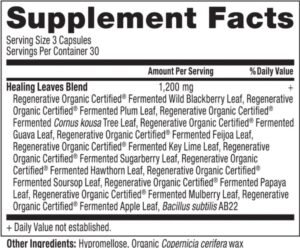
Three capsules contain 1200 mg of the following 13 ingredients
- Regenerative Organic Certified® Fermented Wild Blackberry Leaf
Source HealingLeaves.com, accessed September 2026 - Regenerative Organic Certified® Fermented Plum Leaf
- Regenerative Organic Certified® Fermented Cornus kousa Tree Leaf
- Regenerative Organic Certified® Fermented Guava Leaf
- Regenerative Organic Certified® Fermented Feijoa Leaf
- Regenerative Organic Certified® Fermented Key Lime Leaf
- Regenerative Organic Certified® Fermented Sugarberry Leaf
- Regenerative Organic Certified® Fermented Hawthorn Leaf
- Regenerative Organic Certified® Fermented Soursop Leaf
- Regenerative Organic Certified® Fermented Papaya Leaf
- Regenerative Organic Certified® Fermented Mulberry Leaf
- Regenerative Organic Certified® Fermented Apple Leaf
- Bacillus subtilis AB22
These ingredients are different than the written list appearing on HealingLeaves.com.
Specifically, there are 5 leaves mentioned on the website that do not appear on the Supplement Facts label
| Written capsule ingredients | Supplement Facts ingredients |
|---|---|
| Raspberry | Plum |
| Persimmon | Cornus kousa |
| Fig | Guava |
| Aronia | Feijoa |
| Muscadine grape | Key lime |
Guava Leaf Research
If guava is actually part of the current capsule formula, it has legitimate human research.
One randomized double-blind trial gave adults with knee pain 1 gram of guava-leaf extract daily for 12 weeks.
Pain and stiffness improved compared with placebo.
Guava leaves have also been studied for diarrhea and post-meal blood sugar.
That makes guava one of the more interesting leaves in the capsule Supplement Facts panel.
What Is Bacillus subtilis AB22?
The Healing Leaves capsule Supplement Facts panel lists Bacillus subtilis AB22, also known as NRRL 68053. When I reached out to the company, they told me to use this “resilient probiotic” to support digestive health, improve nutrient absorption, and promote a balanced immune system.
Bacillus subtilis is a spore-forming bacterium commonly found in the environment. According to a 2024 FDA letter, NRRL 68053 was isolated from a mammalian gastrointestinal tract and is described as non-pathogenic and non-toxigenic.
A patent involving NRRL B-68053 also describes a small human study. Ten healthy adults took 1 billion CFU daily for 42 days. The probiotic appeared well tolerated, and researchers reported improvements in bloating, gas, fatigue, anxiety, and the inflammatory marker TNF-alpha.
Some of these findings tend to support their claim of helping digestive health.
However, this was a very small study (only 10 people) with no placebo group, and I could not locate it as a peer-reviewed published clinical trial. I would consider the results interesting but preliminary.
Microbial Discovery Group also submitted NRRL 68053 to the FDA as Generally Recognized as Safe (GRAS) for use in conventional foods. In its 2024 response, the FDA said it had “no questions” about the company’s GRAS conclusion. However, the FDA specifically states that this is not the same as formally affirming or approving the strain as GRAS.
The FDA notice allowed for it to be used in amounts up to 10 billion CFU per serving, although that should not be interpreted as an effective or recommended dose.
Something else: the Healing Leaves capsule Supplement Facts label doesn’t state how many CFU per serving are in the capsules. This means we don’t know if it provides the 1 billion CFU used in the small study described in the patent.
Are Healing Leaves Tea And Capsules Really The Same?
Healing Leaves says the benefits are the same whether you choose tea or capsules.
But I don’t see enough evidence to conclude that.
The tea and capsules differ in several ways.
- A tea bag contains approximately 3 grams of the leaf blend.
- The loose-leaf product provides approximately 4 grams per tablespoon.
- Three capsules provide only 1.2 grams of their blend.
- The capsules are also fermented.
Based on the Supplement Facts labels, they may not even contain the same 12 leaves. Let’s compare them.
| Ingredient | Capsules | Tea Bags | Loose-Leaf Tea |
|---|---|---|---|
| Blackberry leaf | ✓ Fermented wild blackberry | ✓ Blackberry | ✓ Blackberry |
| Raspberry leaf | — | ✓ | ✓ |
| Mulberry leaf | ✓ Fermented | ✓ | ✓ |
| Hawthorn leaf | ✓ Fermented | ✓ | ✓ |
| Sugarberry leaf | ✓ Fermented | ✓ | ✓ |
| Persimmon leaf | — | ✓ | ✓ |
| Fig leaf | — | ✓ | ✓ |
| Apple leaf | ✓ Fermented | ✓ | ✓ |
| Aronia berry leaf | — | ✓ | ✓ |
| Muscadine grape leaf | — | ✓ | ✓ |
| Papaya leaf | ✓ Fermented | ✓ | ✓ |
| Soursop leaf | ✓ Fermented | ✓ | ✓ |
| Plum leaf | ✓ Fermented | — | — |
| Cornus kousa tree leaf | ✓ Fermented | — | — |
| Guava leaf | ✓ Fermented | — | — |
| Feijoa leaf | ✓ Fermented | — | — |
| Key lime leaf | ✓ Fermented | — | — |
| Bacillus subtilis AB22 | ✓ | — | — |
As you can see from this table, Healing Leaves supplements contain five leaves and one probiotic strain that are not found in either the teabags or loose-leaf tea versions. The capsules also contain fermented versions of tea leaves.
That said, I was unable to locate a human study on Healing Leaves capsules vs. tea bags to show one is better than another.
How Much Healing Leaves Should You Use?
Healing Leaves says the recommended amount is 1 to 2 cups per day.
But the FAQ Page also provides an “advanced usage” option for people who want a greater quantity or concentration.
The company suggests:
Tea bags: 2 to 3 bags per serving, 2 to 3 times per day.
Loose leaf: 2 to 3 heaping tablespoons per serving, 2 to 3 times per day.
Capsules: 6 to 9 capsules per day.
The FAQ states this larger amount with “maximum benefits.”
But I could not locate clinical evidence showing that these larger doses provide greater benefits.
How Much Does Healing Leaves Cost?
When I checked, a 30-serving package cost approximately:
One-time purchase: $64.95
Subscribe & Save: $59.95
That’s about $2.17 per serving before subscription savings.
But, using more for “maximum benefits” changes how much customers pay.
Healing Leaves Capsules Cost
A bottle contains 90 capsules. Here’s a breakdown of how long a bottle will last depending on how much you take.
3 capsules/day: 30 days
6 capsules/day: 15 days
9 capsules/day: 10 days
At $64.95 per bottle, taking six to nine capsules daily would cost approximately $130 to $195 per month.
Tea Bags Cost
A package contains 30 tea bags.
Using four bags per day requires roughly four packages each month.
Using nine bags per day requires roughly nine packages.
At the one-time price of $64.95, that works out to approximately:
$260 to $585 per month.
How To Cancel A Healing Leaves Subscription
The website states they have a “No commitment. Cancel anytime” policy.
Customers can modify subscriptions online, but cancellation requires calling customer support.
The support number listed is: 1-800-301-9731
What Is The Healing Leaves Return Policy?
Healing Leaves offers a 30-day money-back guarantee.
The 30 days begin on the date it’s shipped to you and:
- shipping and taxes aren’t refunded (that’s standard for pretty much all companies)
- customers should contact support before returning products
- improperly returned items may not qualify for refunds
- refund processing may take 2 to 3 weeks after the return reaches the warehouse
- orders usually cannot be canceled after processing starts
Do Healing Leaves Tea Bags Contain Microplastics?
Healing Leaves says its tea bags are made from wood pulp.
The company also says they have not specifically tested the bags for microplastics.
If microplastics are a concern, the loose-leaf version is a better option as it avoids the tea bag altogether.
I think the company deserves some credit for being straightforward about the lack of microplastic testing.
Does Healing Leaves Test For Heavy Metals?
Healing Leaves says every batch undergoes independent third-party testing for:
- heavy metals
- microbial contamination
- purity
- quality
That’s good.
What I didn’t see was a Certificate of Analysis on the website.
When I reached out to the company, they replied that every batch is independently tested for heavy metals, microbial contamination, purity, and quality.
However, it does not provide lot-specific Certificates of Analysis to consumers. They do state all their products are made and tested in accordance with applicable industry standards and regulatory requirements.
Where Are Healing Leaves Ingredients Grown?
The website gives slightly different answers depending on the page.
One FAQ says:
All ingredients are grown on Regenerative Organic Certified farms in the USA.
But the company’s About Jordan page says Healing Leaves combines leaves from its Tennessee and Missouri farms with ingredients from certified organic farms globally.
The product pages also say ingredients come from company farms and certified-organic farms around the world.
Based on those statements, I think it’s safe to assume that some of Healing Leaves’ ingredients come from its own Regenerative Organic Certified farms in Tennessee and Missouri, while other ingredients appear to come from certified-organic growers in other countries.
Healing Leaves Customer Reviews
From the verified customer comments on the website, most people really like the product, giving it 4- and 5-star ratings. Some of those same customers also said Healing Leaves felt expensive and should cost less.
Some of those who rated it poorly stated:
- the tea bags were thin, leaked contents or broke open in the cup after being exposed to hot water
- could not use it becuase of the medications they were using
- product never arrived after ordered
- customer service is outsourced
Many people commented on the low quality of the tea bags.
To the company’s credit, they do not delete negative customer reviews.
Healing Leaves Side Effects
The company says the tea is generally well tolerated but recommends that people taking medications, pregnant or breastfeeding women, and people with health conditions speak with a healthcare professional before using it.
Based on the ingredients, here are a few more specific suggestions
Diabetes medications
Mulberry leaf appears to lower blood sugar and, in theory, may interact with diabetes medications.
Heart and blood-pressure medication
Hawthorn may lower blood pressure and affect heart function.
Long-term soursop intake
Because soursop leaves can contain annonacin and related acetogenins, I would like to see Healing Leaves provide testing results showing whether its processing reduces or removes them.
Does Healing Leaves Support Healthy Blood Sugar?
This is the Healing Leaves claim I find most plausible.
Mulberry has human evidence on this. Fig leaf has some research too.
So, in theory, it’s possible Healing Leaves may lower blood sugar, but by how much is not known.
Does Healing Leaves Boost Energy?
Healing Leaves is caffeine-free. I could not find human research showing that Healing Leaves improves energy or reduces fatigue.
Does Healing Leaves Support Immunity?
Many Healing Leaves ingredients contain polyphenols and other compounds that can influence immune pathways in laboratory studies.
But that isn’t necessarily the same as showing that people who drink Healing Leaves:
- get fewer infections
- recover faster after the flu
- develop stronger immune systems
So, for now, I’d say this claim is unproven.
Does Healing Leaves Reduce Inflammation?
This claim does make some sense.
Several fruit-tree leaves demonstrate anti-inflammatory effects- at least in cells and animal studies.
But does that mean drinking tea produces anti-inflammatory effects in people?
And if it did, would that lead to meaningful health outcomes like less arthritis pain?
For now, that question deserves more study.
Does Healing Leaves Detox The Body?
The Healing Leaves FAQ says the product promotes healthy “detoxification.”
But what exactly does detoxification mean here? What specifically is being detoxified?
Something else: if Healing Leaves really does “support detoxification,” could it change how quickly the body breaks down or clears medications?
This thought experiment is, of course, speculation; I mention it to point out that detoxing the body can have good-and not-so-good applications.
For what it’s worth, I was unable to find human studies showing that Healing Leaves improves detoxification in humans.
Does Healing Leaves Promote Longevity?
The leaves contain polyphenols, flavonoids, antioxidants, and other healthy compounds.
That’s not the same as proving they increase human lifespan or healthspan.
I found no human clinical evidence showing that Healing Leaves:
- extends life of people
- slows biological aging
- delays age-related disease like dementia
- improves markers of longevity like telomere length
Tea is a healthy drink, but the question is whether Healing Leaves is better than green tea or other teas.
Is Healing Leaves Gluten-Free?
The company says Healing Leaves is formulated without gluten-containing ingredients.
That’s good, but it also says the product has not been formally tested or certified gluten-free.
On the plus side, tea is generally gluten-free, and none of the ingredients in Healing Leaves would be expected to contain gluten naturally.
The main potential concern would be accidental cross-contamination. For example, if the product were made in a facility that also processes wheat, barley, or rye. To be clear, there is no evidence this is happening with Healing Leaves.
For people with celiac disease or severe gluten sensitivity, I would double-check with the company about its manufacturing process and whether the finished products are tested for gluten.
Healing Leaves Pros And Cons
| Pros | Cons |
|---|---|
| Interesting fruit-tree leaf formula | Clinical trials can’t be located |
| Mulberry has good human research | Individual ingredient doses aren’t listed |
| Several ingredients have human studies | Much of the research seems preclinical |
| Caffeine-free | Soursop |
| Organic/regenerative sourcing | Website ingredient information conflicts |
| Third-party testing claimed | COAs aren’t prominently available |
| Has multiple versions | Capsules and tea may contain different leaves |
| Negative reviews remain visible | Expensive |
| 30-day guarantee | Cancellation requires a phone call |
Does Healing Leaves Really Work? My Bottom Line
Healing Leaves contains several ingredients with some human research behind them, especially mulberry. From what I can determine, most of the other leaves appear to have limited evidence. I wish the company had invested in a clinical trial. Founder Jordan Rubin previously founded Garden of Life and co-founded Ancient Nutrition, two highly successful supplement brands.
While most people like this beverage, the human evidence so far does not seem strong enough to show that Healing Leaves lives up to its health claims.
Healing Leaves FAQ
Does Healing Leaves contain caffeine?
No. Healing Leaves is marketed as caffeine-free.
Is Healing Leaves clinically proven?
I could not locate a published clinical trial of the complete Healing Leaves product. Some individual ingredients have been clinically studied.
Does Healing Leaves lower blood sugar?
Healing Leaves itself hasn’t been clinically shown to lower blood sugar. Mulberry leaf, however, has multiple human studies suggesting effects on glucose control.
Can Healing Leaves cure cancer?
There is no clinical evidence that Healing Leaves cures cancer.
Is Healing Leaves safe?
Several ingredients appear reasonably well tolerated in limited studies, but medication interactions and long-term soursop exposure deserve consideration.
Are Healing Leaves tea bags plastic-free?
The company says its bags are made from wood pulp but acknowledges that they have not specifically been tested for microplastics.
Is Healing Leaves FDA-approved?
The FDA does not approve conventional foods such as tea before they are sold. Healing Leaves says its tea is GRAS, which means Generally Recognized as Safe. GRAS refers to safety, not effectiveness.
Is Healing Leaves a Scam?
I would not go as far as saying it is a scam because Healing Leaves is a real product made by a legitimate company. As I see it, though, the better question to ask is whether the human research supports the health claims. For now, I don’t think the evidence is strong enough to show Healing Leaves lives up to its advertised claims.
Have you tried Healing Leaves? Did you notice any benefits, side effects, or problems? Share your experience below.
Further Reading